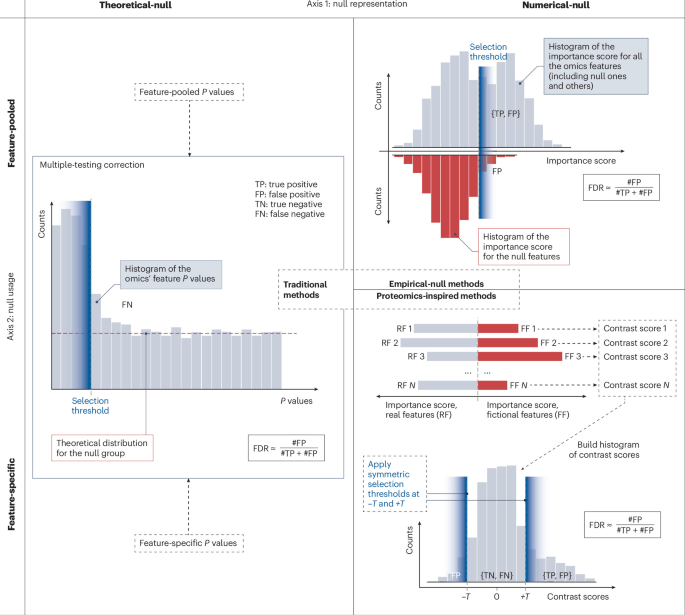
False discovery rate (FDR) control is central to omics research, yet the diverse procedures used rely on different assumptions. This Comment proposes a 2 × 2 matrix that helps sequencing-based and mass-spectrometry-based omics researchers choose the appropriate family of FDR procedures, or alternative methods that may be more rigorous, depending on data and study design.
This is a preview of subscription content, access via your institution
Access options
Access through your institution
Access Nature and 54 other Nature Portfolio journals
Get Nature+, our best-value online-access subscription
$39.99 / 30 days cancel any time
Subscribe to this journal
Receive 12 print issues and online access
$259.00 per year only $21.58 per issue
Buy this article
- Purchase on SpringerLink
- Instant access to the full article PDF.
USD 39.95
Prices may be subject to local taxes which are calculated during checkout

References
-
Benjamini, Y. & Hochberg, Y. J. R. Stat. Soc. Series B Stat. Methodol. 57, 289–300 (1995).
-
Benjamini, Y. & Yekutieli, D. Ann. Stat. 29, 1165–1188 (2001).
-
Elias, J. E. & Gygi, S. P. Nat. Methods 4, 207–214 (2007).
-
Scheubert, K. et al. Nat. Commun. 8, 1494 (2017).
-
Barber, R. F. & Candès, E. J. Ann. Stat. 43, 2055–2085 (2015).
-
Ge, X. et al. Genome Biol. 22, 288 (2021).
-
Efron, B. J. Am. Stat. Assoc. 99, 96–104 (2004).
-
Tusher, V. G., Tibshirani, R. & Chu, G. Proc. Natl Acad. Sci. USA 98, 5116–5121 (2001).
-
Käll, L., Storey, J. D., MacCoss, M. J. & Noble, W. S. J. Proteome Res. 7, 29–34 (2008).
-
Li, Y., Ge, X., Peng, F., Li, W. & Li, J. J. Genome Biol. 23, 79 (2022).
-
Danilova, Y., Voronkova, A., Sulimov, P. & Kertész-Farkas, A. J. Proteome Res. 18, 2354–2358 (2019).
-
Etourneau, L. & Burger, T. J. Proteome Res. 21, 2840–2845 (2022).
-
Wen, B., Freestone, J., Riffle, M., MacCoss, M. J., Noble, W. S. & Keich, U. Nat. Methods 22, 1454–1463 (2025).
-
Zhou, H. J., Ge, X. & Li, J. J. Genome Biol. 26, 207 (2025).
-
Freestone, J., Short, T., Noble, W. S. & Keich, U. Bioinformatics 38, ii82–ii88 (2022). (Suppl. 2).
Acknowledgements
The authors are grateful to Changhu Wang and Chandra Sekhar Mukherjee at the Fred Hutchinson Cancer Center for their valuable feedback. T.B. is supported by the following grants from the French National Research Agency: ProFI project (ANR-10-INBS-08), GRAL CBH project (ANR-17-EURE-0003), France 2030 programme (ANR-19-P3IA-0003), PeptidOMS project (ANR-24-CE45-3296) and ProteoVir project (ANR-24-RRII-0001). J.J.L. is supported by the following grants from the US National Institutes of Health: NIGMS R35GM140888 and NHGRI R01HG014687.
Ethics declarations
Competing interests
The authors declare no competing interests.
Supplementary information
Rights and permissions
About this article

Cite this article
Burger, T., Ge, X. & Li, J.J. A unified and practical taxonomy for false discovery rate control in omics research. Nat Biotechnol (2026). https://doi.org/10.1038/s41587-026-03379-8
-
Published:
-
Version of record:
-
DOI: https://doi.org/10.1038/s41587-026-03379-8