Data availability
Sequencing data associated with this study are available from the National Center for Biotechnology Information Sequence Read Archive under BioProject (PRJNA1366125). Statistical source data underlying the figures are provided in Source Data. Complete variant, plasmid, primer and statistical summary information are provided in Supplementary Tables. Source data are provided with this paper.
Code availability
Custom code used to process and analyze data from this study is available through the Shipman Lab GitHub repository (https://github.com/Shipman-Lab/Detectron).
References
-
Betzer, O. et al. In vivo neuroimaging of exosomes using gold nanoparticles. ACS Nano 11, 10883–10893 (2017).
-
Sheth, R. U., Cabral, V., Chen, S. P. & Wang, H. H. Manipulating bacterial communities by in situ microbiome engineering. Trends Genet. 32, 189–200 (2016).
-
Ganeshan, S. D. & Hosseinidoust, Z. Phage therapy with a focus on the human microbiota. Antibiotics 8, 131 (2019).
-
Zhan, Y., Buchan, A. & Chen, F. Novel N4 bacteriophages prevail in the cold biosphere. Appl. Environ. Microbiol. 81, 5196–5202 (2015).
-
Green, A. A., Silver, P. A., Collins, J. J. & Yin, P. Toehold switches: de novo-designed regulators of gene expression. Cell 159, 925–939 (2014).
-
Green, A. A. et al. Complex cellular logic computation using ribocomputing devices. Nature 548, 117–121 (2017).
-
Pardee, K. et al. Rapid, low-cost detection of Zika virus using programmable biomolecular components. Cell 165, 1255–1266 (2016).
-
Takahashi, M. K. et al. A low-cost paper-based synthetic biology platform for analyzing gut microbiota and host biomarkers. Nat. Commun. 9, 3347 (2018).
-
Yan, Z. et al. Programmable fluorescent aptamer-based RNA switches for rapid identification of point mutations. Nat. Chem. 17, 1826–1838 (2025).
-
Yan, Z. et al. Rapid, multiplexed, and enzyme-free nucleic acid detection using programmable aptamer-based RNA switches. Chem 10, 2220–2244 (2024).
-
Zhou, Y. et al. Conditional RNA interference in mammalian cells via RNA transactivation. Nat. Commun. 15, 6855 (2024).
-
Millman, A. et al. Bacterial retrons function in anti-phage defense. Cell 183, 1551–1561 (2020).
-
Yee, T., Furuichi, T., Inouye, S. & Inouye, M. Multicopy single-stranded DNA isolated from Myxococcus xanthus. Cell 38, 203–209 (1984).
-
González-Delgado, A. et al. Simultaneous multi-site editing of individual genomes using retron arrays. Nat. Chem. Biol. 20, 1482–1492 (2024).
-
Crawford, K. D., Khan, A. G., Lopez, S. C., Goodarzi, H. & Shipman, S. L. High-throughput variant libraries and machine learning yield design rules for retron gene editors. Nucleic Acids Res. 53, gkae123 (2025).
-
Khan, A. G. et al. An experimental census of retrons for DNA production and genome editing. Nat. Biotechnol. 43, 914–922 (2024).
-
Lopez, S. C., Crawford, K. D., Lear, S. K., Bhattarai-Kline, S. & Shipman, S. L. Precise genome editing across kingdoms of life using retron-derived DNA. Nat. Chem. Biol. 18, 199–206 (2022).
-
Kong, X. et al. Precise genome editing without exogenous donor DNA via retron editing system in human cells. Protein Cell 12, 899–902 (2021).
-
Zhao, B., Chen, S. A. A., Lee, J. & Fraser, H. B. Bacterial retrons enable precise gene editing in human cells. CRISPR J. 5, 31–39 (2022).
-
Lim, D. & Maas, W. K. Reverse-transcriptase-dependent synthesis of a covalently linked, branched DNA–RNA compound in E. coli B. Cell 56, 891–904 (1989).
-
Palka, C., Fishman, C. B., Bhattarai-Kline, S., Myers, S. A. & Shipman, S. L. Retron reverse-transcriptase termination and phage defense are dependent on host RNase H1. Nucleic Acids Res. 50, 3490–3504 (2022).
-
Chen, T. & Guestrin, C. XGBoost: a scalable tree boosting system. In Proc. 22nd ACM SIGKDD International Conference on Knowledge Discovery and Data Mining (eds Krishnapuram, B. & Shah, M.) 785–794 (ACM, 2016).
-
Gootenberg, J. S. et al. Nucleic acid detection with CRISPR–Cas13a/C2c2. Science 356, 438–442 (2017).
-
Kellner, M. J., Koob, J. G., Gootenberg, J. S., Abudayyeh, O. O. & Zhang, F. SHERLOCK: nucleic acid detection with CRISPR nucleases. Nat. Protoc. 14, 2986–3012 (2019).
-
Gootenberg, J. S. et al. Multiplexed and portable nucleic acid detection platform with Cas13, Cas12a, and Csm6. Science 360, 439–444 (2018).
-
Jiao, C. et al. Noncanonical crRNAs derived from host transcripts enable multiplexable RNA detection by Cas9. Science 370, 1087–1094 (2020).
-
McKenna, A. et al. Whole-organism lineage tracing by combinatorial and cumulative genome editing. Science 353, aaf7907 (2016).
-
Frieda, K. L. et al. Synthetic recording and in situ readout of lineage information in single cells. Nature 541, 107–111 (2017).
-
Perli, S. D., Cui, C. H. & Lu, T. K. Continuous genetic recording with self-targeting CRISPR–Cas in human cells. Science 353, aag0511 (2016).
-
Choi, J. et al. A time-resolved, multi-symbol molecular recorder via sequential genome editing. Nature 608, 98–107 (2022).
-
Tang, W. & Liu, D. R. Rewritable multi-event analog recording in bacterial and mammalian cells. Science 360, eaap9751 (2018).
-
Farzadfard, F. et al. Single-nucleotide-resolution computing and memory in living cells. Mol. Cell 75, 769–780.e4 (2019).
-
Shipman, S. L., Nivala, J., Macklis, J. D. & Church, G. M. Molecular recordings by directed CRISPR spacer acquisition. Science 353, aaf1175 (2016).
-
Bhattarai-Kline, S. et al. Recording gene expression order in DNA by CRISPR addition of retron barcodes. Nature 608, 217–225 (2022).
-
Sheth, R. U., Yim, S. S., Wu, F. L. & Wang, H. H. Multiplex recording of cellular events over time on CRISPR biological tape. Science 374, eabi5919 (2021).
-
Farzadfard, F. & Lu, T. K. Genomically encoded analog memory with precise in vivo DNA writing in living cell populations. Science 346, 1256272 (2014).
-
Roquet, N., Soleimany, A. P., Ferris, A. C., Aaronson, S. & Lu, T. K. Synthetic recombinase-based state machines in living cells. Science 353, aad6350 (2016).
-
Mosberg, J. A., Gregg, C. J., Lajoie, M. J., Wang, H. H. & Church, G. M. Improving lambda red genome engineering in Escherichia coli via rational removal of endogenous nucleases. PLoS ONE 7, e44638 (2012).
Acknowledgements
We thank K. S. Pollard for discussions regarding machine learning, K. D. Crawford for discussions regarding Detectron library construction and A. G. Delgado for assistance in assessing Detectron portability.
Funding
Work was supported by funding from the Bachrach Family Foundation and the Robert J. Kleberg, Jr. and Helen C. Kleberg Foundation. S.L.S. is a San Francisco Biohub Investigator.
Ethics declarations
Competing interests
J.H. and S.L.S. are named inventors on US provisional patent application no. 63/900,194, related to the technologies described in this work.
Peer review
Peer review information
Nature Biotechnology thanks Alexander Green, Baojun Wang and the other, anonymous, reviewer(s) for their contribution to the peer review of this work. Peer reviewer reports are available.
Additional information
Publisher’s note Springer Nature remains neutral with regard to jurisdictional claims in published maps and institutional affiliations.
Extended data
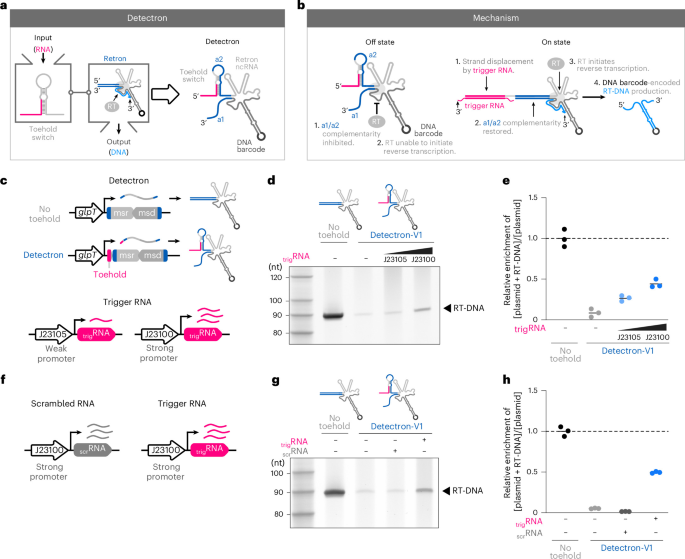
Extended Data Fig. 1 Detectrons specifically respond to target RNA expressed under an inducible promoter.
a, Schematic of the experimental promoters used to express No Toehold control, Detectron, and trigger RNA, along with representations of the expressed transcripts. msr, multicopy single-stranded RNA. msd, multicopy single-stranded DNA. trigRNA, trigger RNA. b, Representative urea PAGE analysis of RT-DNA from the No Toehold control (lane 1, excluding ladder) and from Detectron in the absence (lane 2) or presence of trigger RNA expressed under the pBAD promoter (lane 3), or in the absence (lane 4) or presence of scrambled RNA expressed under the pBAD promoter (lane 5). The experiment was repeated independently three times with similar results.
Extended Data Fig. 2 Construction of the Detectron variant library.
a, Schematic of retron Eco1 ncRNA variants tested. b, Representative urea PAGE analysis of RT-DNA from the indicated ncRNA variants (lanes 1-4, excluding ladder) and wild-type (WT) ncRNA (lane 5). c, Representative urea PAGE analysis of RT-DNA from the No Toehold control (lane 1, excluding ladder) and Detectron-V1 in the absence (lane 2) or presence of trigger RNA expressed under the J23105 promoter (lane 3) or J23100 promoter (lane 4). The experiments shown in b and c were repeated independently three times with similar results. d, Design of Detectron variant oligonucleotides. The invariable region containing the full msr and partial msd sequences was omitted from synthesized oligos. e, Pooled oligos were cloned into either on (constitutively expressing trigger RNA) or off (no trigger RNA expression) backbones via SapI digestion. The invariable region was subsequently reinserted into both on and off libraries via BsaI digestion.
Extended Data Fig. 3 Effect of shorter loop lengths on Detectron performance.
a, Schematic of the focused loop-length analysis. To isolate the effect of loop length from changes in a2 length, a2 was fixed at 12 nt by excluding the loop from the a2 sequence, while loop length was varied from 12 nt to shorter lengths of 11, 9, 7, 5, 3, and 1 nt. b, Enrichment of RT-DNA + plasmid over plasmid alone for Detectrons with the indicated loop lengths, as measured by qPCR; One-way ANOVA followed by two-sided Tukey’s multiple comparisons test with adjustment for multiple comparisons for on-state signal: 11 nt versus 12 nt: P = 0.0970; 9 nt versus 12 nt: P = 0.995; 7 nt versus 12 nt: P = 4.82 × 10⁻⁷; 5 nt versus 12 nt: P = 3.35 × 10⁻¹⁰; 3 nt versus 12 nt: P = 3.35 × 10⁻⁸; 1 nt versus 12 nt: P = 0.543. Closed circles indicate three biological replicates. Bars represent the mean (±s.d.) of three biological replicates. c, on/off ratios of Detectrons with the indicated loop lengths; One-way ANOVA followed by two-sided Tukey’s multiple comparisons test with adjustment for multiple comparisons: 11 nt versus 12 nt: P = 0.230; 9 nt versus 12 nt: P = 0.374; 7 nt versus 12 nt: P = 5.62 × 10⁻⁸; 5 nt versus 12 nt: P = 1.44 × 10⁻¹⁰; 3 nt versus 12 nt: P = 4.13 × 10⁻⁶; 1 nt versus 12 nt: P = 0.430. Bars represent the mean (±s.d.) of three biological replicates.
Extended Data Fig. 4 Machine learning-based model training identifies optimal structural feature set for Detectron performance prediction.
a, Schematic of the machine learning workflow using XGBoost regression trained on the indicated feature sets. b, Model performance for each fold was evaluated using coefficient of determination (R2), root mean squared error (RMSE), mean absolute error (MAE), and Pearson’s correlation coefficient (r). c, Average of performance metrics across the five outer cross-validation folds. d, Paired t-tests comparing performance metrics between the indicated feature-set models.
Extended Data Fig. 5 Average on/off ratios and SHAP feature effects across Detectron structural parameters.
a-b, SHAP analysis of on/off ratios across (a) stem2 and (b) stem1 lengths. Each circle represents an individual Detectron variant. Bars represent the mean SHAP value of the variants. c-f, Average on/off ratios across different feature distributions: (c) combined stem lengths; (d) loop lengths; (e) bulge lengths; and (f) distance from stem to priming G. Closed circles indicate three biological replicates. Bars represent the mean (±s.d.) of three biological replicates. g, Average on/off ratios plotted against free energy of the hairpin (ΔGhairpin). Each circle represents an individual Detectron variant.
Extended Data Fig. 6 Effect of extended trigger-complementary stem pairing on Detectron performance.
a, Normalized on/off ratios of Detectron variants in which stem2 was present (stem2 ≥ 1 bp) and stem1 length was varied. b, Normalized on/off ratios of Detectron variants in which stem2 was absent (stem2 = 0) and stem1 length was varied, such that the full stem consisted of the trigger-complementary stem1 region. In both panels, bulge, loop and d lengths were held constant at 0 nt, 12 nt and 1 nt, respectively.
Extended Data Fig. 7 Target-site selection affects Detectron-V2 performance within gp23 mRNA.
a, Schematic of four 33-nt target sites selected within the full-length T4 gp23 mRNA. The 25-nt binding region within each target site represents the sequence expected to mediate initial hybridization with the Detectron-V2 switch RNA. Predicted target-site opening energies (ΔGopen) for the 25-nt binding regions were calculated using RNAplfold; lower ΔGopen values indicate greater predicted local accessibility. b, on/off ratios of Detectron-V2 devices targeting the indicated sites, plotted against the predicted opening energy of the corresponding 25-nt binding region. Closed circles indicate three biological replicates. Bars represent the mean of three biological replicates.
Extended Data Fig. 8 MOI-dependent response of T7-targeting Detectron.
Barcode enrichment from the T7-targeting Detectron strain following infection with T7 phage at the indicated multiplicities of infection (MOIs). For the MOI titration, the initial bacterial density was kept constant and the amount of T7 phage was varied to achieve the indicated MOIs. Barcode abundance was normalized to the WT barcode and plotted as fold change relative to the no-infection control. Bars represent the mean (±s.d.) of three biological replicates.
Supplementary information
Supplementary Information (download PDF )
Supplementary Text, Figs. 1–5 and legend.
Reporting Summary (download PDF )
Peer Review file (download PDF )
Supplementary Tables 1–5 (download XLSX )
Complete Detectron variant and barcode sequence table, including skpp15 primer assignments, variable switch-region sequences, barcode sequences, msd/a2 sequences, padding sequences and full synthesized oligonucleotide sequences with and without padding. Statistical summary table, including statistical tests, sample sizes, exact P values, test statistics, degrees of freedom, confidence intervals, effect sizes and multiple-comparison adjustments where applicable. Plasmid information table, including plasmid names, descriptions and relevant construct information. Detectron and trigger RNA sequences information table, including sequences for Detectron construct and trigger RNA used in this study. Primer sequence table, including primer names and oligonucleotide sequences used in this study.
Source data
Rights and permissions
Springer Nature or its licensor (e.g. a society or other partner) holds exclusive rights to this article under a publishing agreement with the author(s) or other rightsholder(s); author self-archiving of the accepted manuscript version of this article is solely governed by the terms of such publishing agreement and applicable law.
About this article

Cite this article
Han, J., Shipman, S.L. Detectrons convert transient RNA sequences into stable DNA barcodes for high-throughput analysis of RNA-dependent processes. Nat Biotechnol (2026). https://doi.org/10.1038/s41587-026-03334-7
-
Received:
-
Accepted:
-
Published:
-
Version of record:
-
DOI: https://doi.org/10.1038/s41587-026-03334-7