Category: robots

  • Tiny robots powered by light can hunt down and collect bacteria

    Tiny robots powered by light can hunt down and collect bacteria

    Robots small enough to operate in the microbial world could give scientists a new way to directly handle objects that are impossible to manipulate by hand. These tiny machines are around 50 times smaller than the diameter of a human hair, bringing researchers closer to the long-pursued goal of interacting directly with the microscopic world.

    That capability could be especially useful for biological materials in water, including individual cells and bacteria. Precisely controlling and moving objects at this scale has been a persistent challenge. The newly developed nanorobots show that it is already possible to collect bacteria, transport them, and release them at selected locations.

    Light Powers and Steers the Tiny Robots

    One of the biggest obstacles in developing machines this small is finding an effective way to propel and control them. At Julius-Maximilians-Universität Würzburg (JMU), a research team led by Professor Bert Hecht has been developing a solution that uses the recoil produced by individual photons to move microscopic devices known as microdrones.

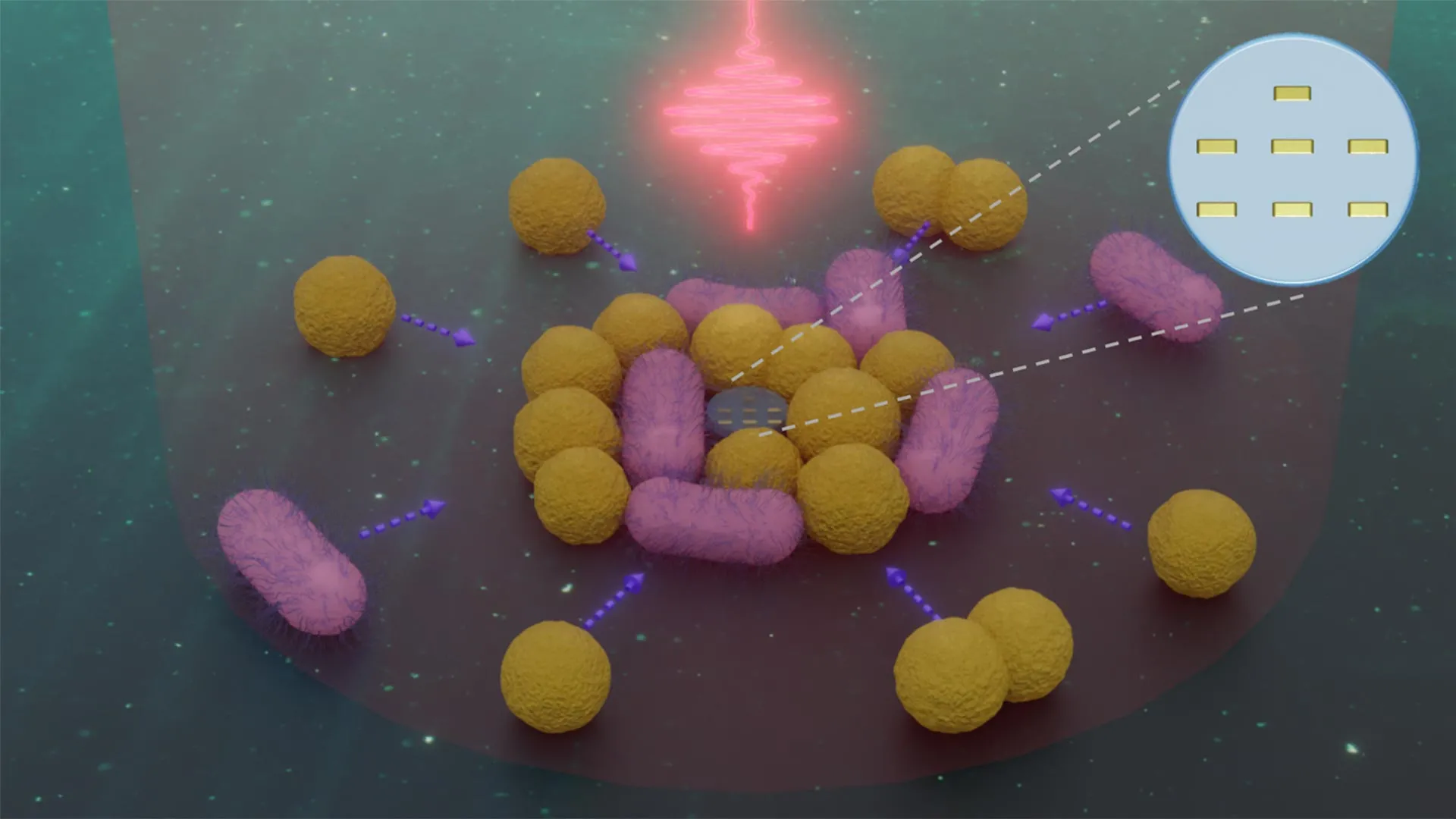
    The devices contain as many as four plasmonic nanoantennas. These antennas absorb light with a particular color and helicity, then emit that light in a specific direction. Redirecting each photon creates a tiny recoil force, similar in principle to the recoil produced when a bullet is fired. Because the microdrones have so little mass, those extremely small forces can generate substantial acceleration and speed.

    For the latest work, the researchers reduced the size of their light-powered robots even further, producing devices smaller than one micrometer. Simplifying the steering system was an important part of achieving that size while retaining propulsion based on photon recoil.

    The new control method takes advantage of nanoscale antenna wires built into the robot. These wires naturally tend to align with the polarization direction of incoming light. By changing the light’s polarization, the researchers can control which direction the nanorobot faces. At the same time, photon recoil continues to propel it forward, creating a steering system that works somewhat like the directional control used in larger vehicles.

    Nanorobots Act as “Microscopic Cleaners”

    “In essence, we have built a light-driven nanorobot that can track down and collect bacteria,” says Jin Qin, lead experimental scientist of the study. “By simplifying the design, we reached a size at which these robots can operate directly in the microbial world – almost like microscopic cleaning devices.”

    The robots are also highly maneuverable. They can make extremely fast 90° turns, helping them scan broad areas of a sample in an organized and efficient way. They can also selectively capture, carry, and release substantial numbers of bacteria.

    Under controlled laboratory conditions, this means the nanorobots can effectively “clean” microscopic environments. They gather bacteria from one area and deposit them at specifically chosen locations.

    “This is a striking example of how light can be used not only to observe the microscopic world, but also to actively shape it,” adds Bert Hecht. “The idea of tiny robotic cleaners may sound futuristic, but we are already demonstrating the physical principles that make it possible.”

    The robots remain fully maneuverable even while carrying larger groups of bacteria, although their speed decreases somewhat under the added load. That ability to keep functioning while transporting larger bacterial clusters points to possible future uses in microbiology, biomedical research, and precise manipulation of materials at the microscopic scale.
  • DNA robots could deliver drugs and hunt viruses inside your body

    DNA robots could deliver drugs and hunt viruses inside your body

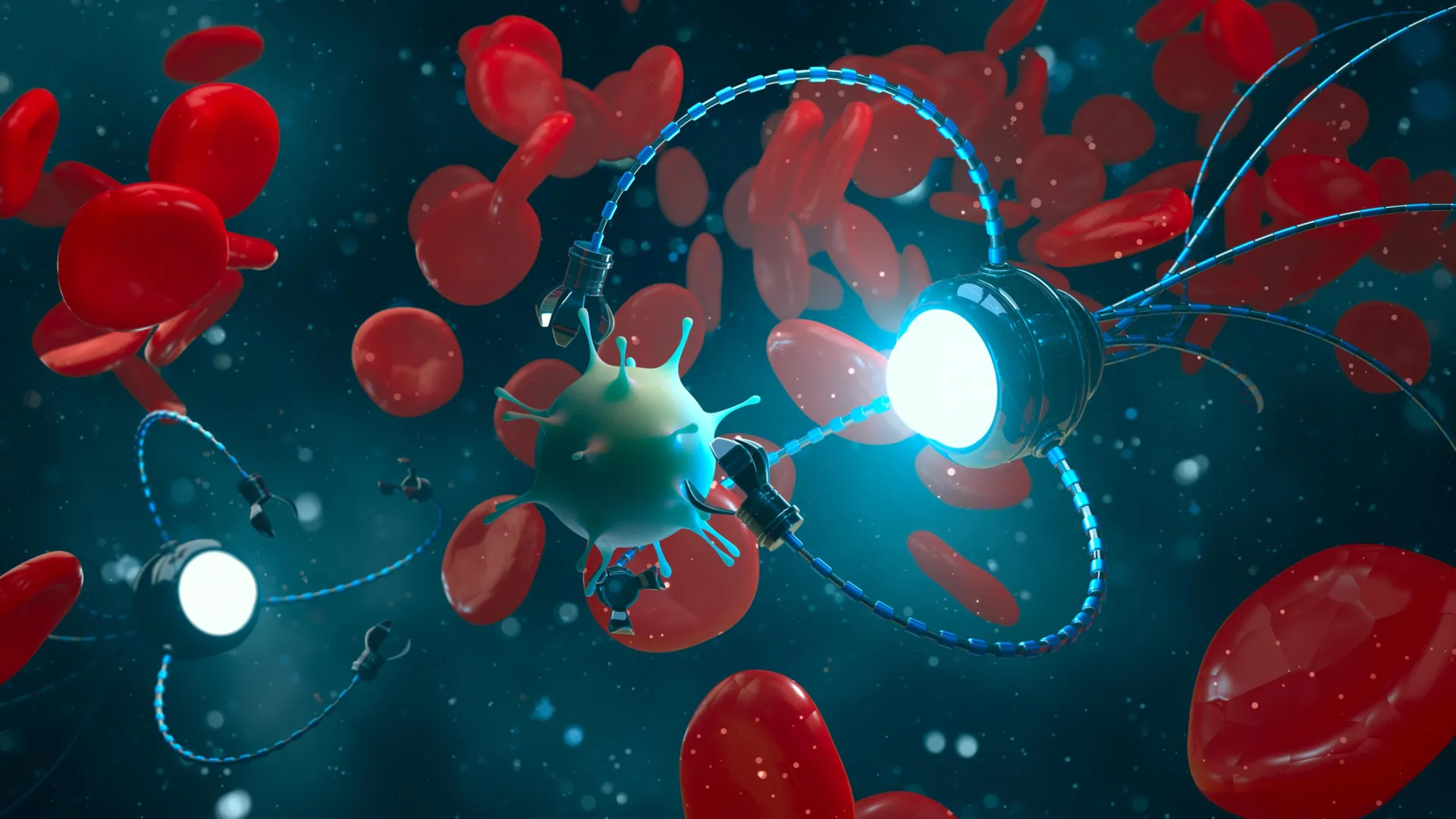
    Imagine tiny robots made from DNA moving through the bloodstream, delivering drugs exactly where they are needed and targeting threats such as cancer cells or viruses. These microscopic machines could also assemble ultra-precise data storage systems and computing devices at the nanometer scale. Although the possibilities are remarkable, most DNA robots today remain in early experimental stages and are better understood as proof of concept rather than practical tools.

    Researchers are exploring how DNA can be engineered into working machines using creative design approaches. These include building rigid DNA joints, incorporating flexible components, and using folding techniques inspired by origami. By applying principles from larger-scale robotics such as rigid, compliant and origami robots, scientists are adapting familiar mechanical concepts to the nanoscale. This allows DNA-based systems to carry out controlled and repeatable tasks despite their extremely small size.

    Controlling Movement in DNA Nanorobots

    Guiding the motion of DNA robots in a constantly shifting molecular environment is a major challenge. To address this, scientists have developed control systems that help these machines behave in predictable ways. One important method involves DNA strand displacement, a biochemical process that enables precise programming of movement using specific DNA sequences labeled as “fuel” and “structure.”

    In addition to biochemical control, external physical signals such as electric fields, magnetic fields, and light can direct how these robots move. Together, these approaches provide a toolkit for fine-tuning the behavior of DNA machines with a high degree of accuracy.

    DNA Robots in Medicine and Technology

    The potential uses for DNA robots extend well beyond laboratory experiments. In medicine, they could function as “nano-surgeons,” locating diseased cells and delivering targeted treatments with precision. Researchers are also exploring whether these machines could capture viruses like SARS-CoV-2, with future systems potentially operating as fully autonomous drug delivery platforms.

    DNA robots may also play a role in advanced manufacturing. Acting as programmable templates, they could position nanoparticles with sub-nanometer accuracy. This capability could lead to breakthroughs in molecular computing and highly efficient optical devices that outperform current technologies.

    Challenges in Scaling DNA Robotics

    Despite rapid progress, several obstacles remain. Moving from large-scale systems to molecular machines introduces challenges such as Brownian motion, which makes precise control more difficult. Many current DNA robot designs are still relatively simple and operate in isolation, limiting their usefulness in complex real-world environments.

    There are also gaps in foundational knowledge. Researchers still lack detailed databases describing the mechanical properties of DNA structures, and simulation tools for predicting behavior at this scale are not yet fully developed.

    What Needs To Happen Next

    To overcome these barriers, scientists emphasize the need for collaboration across disciplines. Proposed solutions include creating standardized DNA “parts libraries,” using artificial intelligence to improve design and simulation, and advancing bio-manufacturing methods. Progress in these areas will be essential for scaling DNA robots and integrating them into practical applications in healthcare, manufacturing, and beyond.

    “The robots of tomorrow won’t just be made of metal and plastic,” says the research team. “They will be biological, programmable, and intelligent. They will be the tools that allow us to finally master the molecular world.”